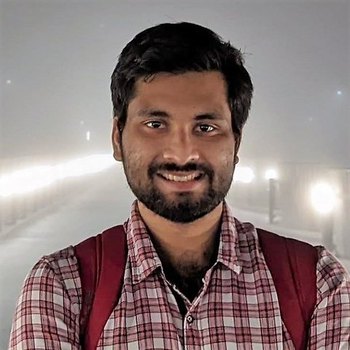
Curriculum Vitae — Sreevatsank Kadaveru
Education
Communication Theory and Systems | PI: Dinesh Bharadia
Communication Theory and Systems | ECE Department
Technology Management Program
Electrical Engineering
Experience
Developed a rigorous framework to study LLMs for RF+Vision based multimodal sensing tasks, to identify and isolate failures to gaps in domain knowledge, domain reasoning or domain-specific data interpretation, and prescribe targeted fine-tuning remedies.
Blind Detection and Tracking of Low Probability of Intercept Signals.
- Developed a novel statistical approach for wideband spectrum sensing, improving state-of-the-art prediction and enabling multi-receiver capability via an optimal cooperative scheduling algorithm. [Poster]
Developed highly automated CI/CD Kubernetes workflows improving reliability and efficiency by 90%.
Improving Reliability of MIMO Mission Critical Systems using LDPC in 5G.
- Demonstrated a novel latency-reliability trade-off in LDPC code selection for video traffic
Research
- PAIQoO: Quantifying the network requirements of Physical AI applications
- Characterizing how sensor fidelity and end-to-end latency trade off in robotic task performance
- mmsRAN: Radio Access Networks for Physical AI [Paper]
- Building an Uplink Scheduler for Multimodal sensor flows that need to be low latency, synchronized and in lock-step order.
- P2SIF: Plug-n-Play Sensor Integration Framework [Proposal]
- Developed a decoupled architecture for new modality integration into existing LLMs without needing to modify LLM weights
- PHYNet: A gold-standard PHY layer labelled dataset
- Establishing a standard for evaluating PHY layer algorithms by building a multi-purpose labelled PHY dataset
- Studied the problem of PHY spectrum ignorance in today’s world
- CamoPHYlage: Hiding signals in plain sight
- Developed adversarial mimicking techniques to evade all PHY layer detectors, enabling surreptitious communication in plain sight
- rfYOLO: Phase modality for better detection
- Developed phase transform to improve PHY layer characterisation of signals using YOLO networks
- Nomad: Architected a high throughput spectrum sensing system with a line rate of 40Gbit/s [Link]
- Developed containerised micro-services with well-defined high throughput shared memory interface
- Achieved major throughput gains with the use of copy-efficient shared memory and a Redis-based in-memory database.
- Curriculum FL: Studied effect of curriculum learning in a federated context. We showed that curriculum can significantly improve convergence time of training. [Paper]
Selected Graduate Projects
- Audio-StyleCLIP: Extended capabilities of StyleCLIP and AudioCLIP models to create a model that can perform style transfer onto an image using an audio styling input. [Report]
- Convexifying Neural Network: Implemented the state-of-the-art technique for modelling a ReLU neural network as a convex optimisation problem, the solution of which is a globally optimal neural network. [Report]
- Training Robust NN: Implemented Lipschitz constant based regularization for training robust Neural Networks and compared performance against L2 and other baseline techniques. [Report]
- Lattice Basis Reduction Performance Study: We evaluate the basis reduction algorithms, such as LLL, BKZ, Slide, Self-dual BKZ, to study accuracy vs performance trade-off on COTS hardware. We also study scaling of these algorithms with problem size. [Report]
Publications
MobiCom’26: “RoboNEST: Robotics Networked Edge Systems Testbed for Physical AI”. [Demo]
MobiCom’26: “WiP: mmsRAN: Multimodal Cellular Uplink for Physical AI”. [Paper]
MobiCom’24: “Nomad: Providing Insights into the Spectrum Environment”. [Paper]
ICCV’23: “When Do Curricula Work in Federated Learning?”. [Paper]
Awards
Qualcomm Innovation Fellowship [Website]2026
Powell Foundation Fellowship [Website]2023
Shah Family Entrepreneurial Fellowship2023
Positions of Responsibility
Teaching Assistant, UCSD2025–26
Graduate & Professional Student Association, Representative, UCSD2023–25
ECE Graduate Student Council, Board Member, UCSD2023–25
Electronics Club, President, IIT Indore2018–19
Team Robocon, Technical Lead, IIT Indore2018–19
Service
S3 Reviewer & Student Panellist: MobiCom2026
Artifact Evaluation Committee: NSDI2026
Artifact Evaluation Committee: SIGCOMM2025
GPSA Award Committee: UCSD2024