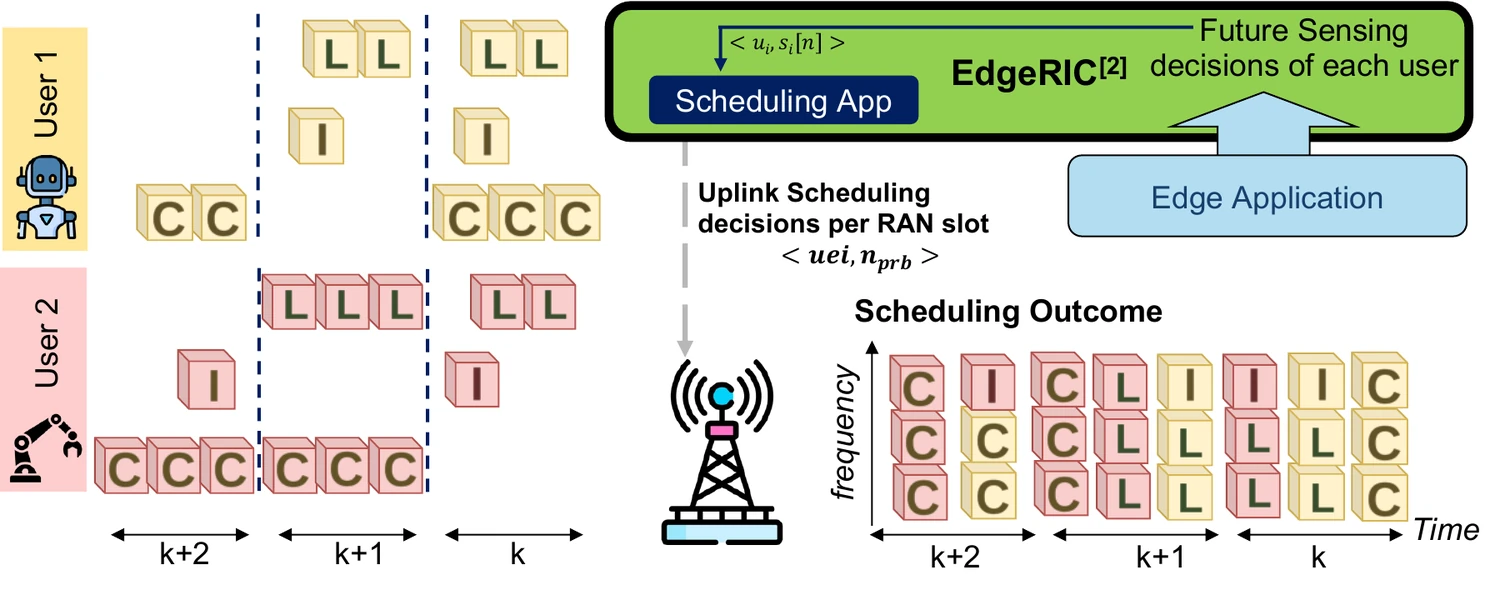
A robot’s control loop operates in discrete timesteps, and the edge application can act only once every sensor stream for a timestep has arrived. Over the cellular uplink, these streams arrive skewed, both across one robot’s sensors and across robots sharing a cell; in our multi-user measurements, skew alone adds approximately 13 ms of latency. mmsRAN is an uplink scheduler for multimodal sensor flows that must be low latency, synchronized, and delivered in lock-step. Each sensor modality receives its own QoS flow and data radio bearer, and a scheduler running on EdgeRIC allocates uplink resources per slot so that a timestep’s streams arrive together. In early over-the-air results on our 5G testbed, network tuning reduced median sensor-frame latency from 30.4 ms to 18.9 ms, and bearer-level prioritization roughly halved the latency of a high-priority stream without starving the others.
@inproceedings{ghosh2026mmsran,
  author    = {Ghosh, Ushasi and Kadaveru, Sreevatsank and Bharadia, Dinesh and Shakkottai, Srinivas},
  title     = {{WiP}: {mmsRAN}: Multimodal Cellular Uplink for Physical {AI}},
  booktitle = {Proceedings of the 32nd Annual International Conference on Mobile Computing and Networking},
  series    = {MobiCom '26},
  pages     = {1677--1680},
  year      = {2026},
  publisher = {ACM},
  doi       = {10.1145/3795866.3844782}
}